
Cardtonic at Web Summit Vancouver 2026: Building a Fintech Giant Without Venture Capital
Vancouver, Canada, June 1, 2026, For years, the tech ecosystem has been defined by a single ritual: chasing venture capital funding. Startups pursue massive fundraising rounds, prioritizing hype and vanity metrics over profitability and real-market utility.

[From L to R: Balogun Usman, Co-founder; Tomisin Oduyemi, Growth Lead; Emmanuel Sohe, Chief Executive Officer]
Cardtonic, a leading fintech platform currently serving over 1.8 million active users across Nigeria and Ghana, followed the unconventional path – scaling without a single dollar of institutional seed capital.
This May, Cardtonic brought its operating philosophy to North America, participating at Web Summit, Vancouver 2026. Cardtonic’s presence at this global summit signals a broader global shift; one where sustainable metrics and disciplined scaling are valued over venture-backed exuberance.
Cardtonic’s Bootstrapping Playbook: Customer-Funded vs. Hype-Funded Scale
Cardtonic’s journey began in 2018 with a clear and distinct mission: to solve the complex cross-border payment issues affecting individuals and businesses in West Africa. This started out as a manual gift card reselling business and rapidly expanded as the business operations became automated. Rather than depending on venture capital funding to survive, Founders Faturoti Kayode and Balogun Usman bootstrapped the business and engineered a system that could sustain itself from the get-go.
In Cardtonic’s playbook, “expansion should be funded by customers and not pitch decks when a business has real market value”. This disciplined framework allowed Cardtonic steadily move from a simple gift card trading platform to a sophisticated multi-product SuperApp. Today, Cardtonic’s ecosystem includes services such as virtual dollar cards, NFC contactless cards, eSIMs, bill payment services, and a gadget store.
By addressing real-world inefficiencies. Cardtonic has organically grown its user base to over 1.8 million active users. This was achieved through strictly upholding their principles on customer-funded revenue and operational resilience.
Exporting African Operational Insight Globally: Web Summit Vancouver 2026
Cardtonic’s participation at the summit represents a symbolic validation moment that further emphasizes the relevance of African innovation in global fintech conversations. It also recognizes Cardtonic as a credible industry voice when it comes to conversations on sustainable economics.
The Web Summit 2026 held at the Vancouver Convention Centre between the 11th and 14th of May, 2026. Chief Executive Officer, Emmanuel Sohe and Growth Lead, Tomisin Oduyemi, represented the firm at the Summit.
Speaking at the Masterclass Session titled “Building a Fintech that Funds Itself; 1.8M + Users Later”, Tomisin emphasised how the company was intentional from inception about growing the business organically, slowly but steadily. They did not see the need to pursue funding rounds just for validation, as “your customers are your first investors”.
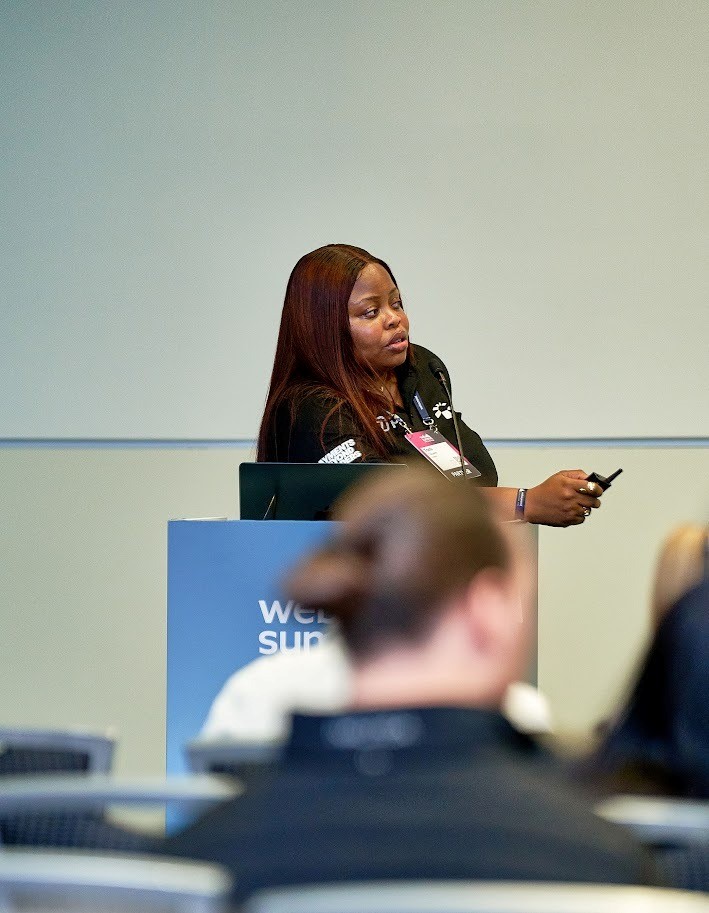
[Tomisin Oduyemi, Growth Lead at Cardtonic, speaking at a Masterclass Session, Web Summit Vancouver, 2026]
“This isn’t a talk about being anti-VC. It’s about understanding when revenue is smarter fuel than external capital and what it takes to build that way”, cited Tomisin in her opening speech.
About how Cardtonic evolved into a multiproduct SuperApp, she noted how none of the consecutive product launches was in the initial plan. “Each product we added answered the same question our founders asked on day one: how does this bring in money? And more importantly, does this solve a real problem for someone who is trying to participate in the global economy but keeps hitting a wall?” Their adherence to their first principle on organic business growth ensured consistent results across the different products.
From Self-Sustenance to Strategic Fundraising: Pil’s $2.1M Fundraising
Cardtonic recently raised $2.1M for its latest spin-off, Pil, a B2B spend-management platform aimed at helping startups and global enterprises create and distribute multi-currency virtual cards with pre-set spending limits to employees for specific needs like software subscriptions and ad campaigns.
This funding round does not signify a diversion from their original investment principle. Instead, it was a sharp acumen of knowing “when to consider external funding and when to walk away from it”. For Pil, it was about diagnosing a problem where “capital was the cheaper/better alternative”. As noted by Tomisin during the speech, “We could’ve said no to raising for Pil but it needed compliance strength, liquidity, and the kind of infrastructural backbone that doesn’t come cheaply”.
The funding round did not also follow the traditional pitch process as the investors were people who had always wanted to be a part of the Cardtonic story over the years, having observed their real-market utility and profitability. “The full amount came from angel investors who had seen our work up close for years. It was less of a business pitch and felt more like inviting people to be characters in a story they had read multiple times”.
Closing Thoughts
African fintechs are now taking a significant role in shaping global fintech conversations on sustainability. With their increased focus on real market value and profitability, they are challenging the new normal and redirecting the startup world away from overinflated valuations and back to fundamental market value.
With Cardtonic’s practical model on self-funded financing and scale, they have proven that a fintech giant can be built through the core values of discipline, operational resilience, and a customer-centric strategy. They have also positioned themselves as a template to always reference when it comes to discussing sustainable fintech growth on the global stage.